Fury of Unuttered Words

On many occasions I attempt to express myself in silence. While I believe this can be a powerful form of expression, I often find that others interpret it as being docile or some oblivious fool/idiot. For yours truly, this generates a fury that far exceeds that of a supposed scorned woman.

This fury torments and fires the soul to hell with one goal in mind: to have words uttered, and not just for utterance sake. The fury demands absolute honesty! Paradoxically, the fury voices its demand in subtle but cunning ways. “You are a free individual”, a voice from within says. “Speak for you will remain a prisoner of (my) fury”. This voice continues until it can no longer be ignored: “speak; speak; speak!”! And what was initially an innocent voice of reason changes to a nagging that surpasses all forms of hell. A hell not imposed by another being/creature but one that stems (uncontrollably) from within.

To end this nagging/hell, free yourself and be bold to utter those words which others may not be prepared to say. Say what you must, for this is all that the fury demands of you. You ignore this demand, the fury of unuttered words becomes unrelenting in its pursuit for truthful words to be uttered –precisely because the fury also serves as an officer for the enforcement of the following law: ‘the truth shall set you free“!

Share

Richness Symbolised

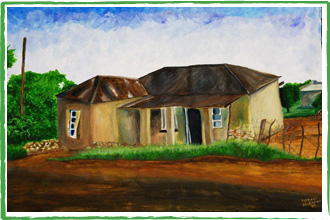
Below is the work of a (relatively) young artist, Michael Selekane, which I acquired in 2009 during the Grahamstown Arts Festival.

When I was rich by Michael Selekane

When I was rich

To this day, I remain very grateful that I made the acquisition. I didn’t have the 850 ZAR that it cost, but like a vulture I circled the piece for a few days until I could no longer resist the temptation to sink a little bit deeper in the abyss of credit card debt. I was beyond certain that I had to have it: I was completely smitten and besotted by the piece that the mere thought of it gracing someone else’s wall brought sinful imagery in my mind, heart and soul.

Looking at it, and reading through the title itself, “when I was rich”, I understood like never before that richness has so many dimensions to it. I understood why the voice of nkhono ‘Machale –the granny that took care of my two sisters when they were babies– had so much affection when she referred to her home as leqhofa; a Sesotho word for a deteriorating house left by a deceased loved one –typically male because of the (customary) laws of ownership.

For nkhono ‘Machale, her house, which was smaller but akin to the one captured by Selekane was a home because it represented the richness of her life. It is perhaps unfortunate that it took Selekane’s work to truly appreciate this fact. In my mind, she was poor to the day she died. I neglected all the other possible dimensions to richness. The contentment, joy, and gratitude that nearly celebrates everything, from the sunrise, the birds to having something to eat, a roof over your head, and a neighbour that is sincerely interested in knowing how you are in greeting you.

I am yet to attain such richness of life but I am nonetheless fortunate to have a symbolic reminder on my wall of what I aspire for. An honest and simple life with many dimensions to it that quantify its richness!

Share

Moqasea

I am really trying hard to get ‘clicking’ in order to communicate in isiXhosa. Enunciating X and C words is proving to be somewhat challenging. The Q words on the other hand are easier to deal with. I suppose this could be explained by the fact that we actually have Q in the Sesotho alphabet — C and X do not exist; “nxa!” in all good conscience cannot be used to contradict my assertion.

With the above said, may I quickly point out that we don’t necessarily have a tide of ‘Q words’, though Q exists in the Sesotho alphabet. I know I could be wrong, but being innately in love with knowing (or speaking from a relatively infallible position) I decided to embark on a little pet project to verify my “facts”. In this project of mine, I tried to find Q words that were not associated with mountains, rivers or other types of landmarks e.g. Senqu, Qiloane, Qhobosheane, Qoqolosing, etc. Then moved on to consider words that could possibly be classified as mundane like: moqoqo (conversation), qabola (to incite laughter), qhibiliha (to melt), seqha (bow or sling –if we make technical accuracy expendable), seqhaqhabola (sour soft porridge). I then progressed to those seriously “cool” words that hardly come in everyday conversation.

An example of a “cool” word that came my path is moqasea. Moqasea is a Sesotho synonym for ‘khethollo‘ (discrimination). Observe how I have decided to go the synonym route, so as to avoid nuances that may exist between the words discrimination and prejudice. This, of course, is intentional and self-serving! First, it allows me to retain my “relative infallible” position. Second, and most importantly, it helps me to (hopefully) hype up the word, which I regard as cool –be it only because it got my poetic juices flowing, see below:

Ka terapola, ka lelera ‘na nthoana batho!
Ke ne ke batlana le makhulo a matala,
Ke batlana le liliba tse sa psheng.
Ka teana le moqasea, ka makala:
Mofuta oa feela oa tšoana le qoba la koae!1

‘Nete ea ba sebabetsane ho ‘na.
Pelo ea hlonama, ea hopola lihlaba tsa Thesele.
Ea re e khutla mafisa, bofifi ba apoha.
Ha luma mantsoe a nkhere, Mohlomi: “pelo ke setlhare”!
Ha hlaka hore ho nena moqasea e le kannete ke pheko.

Ka hona, ke etsa thapeli ke re:
“Ha re neneng moqasea, khotso e rene;
Hoba Seokamela ke ‘Mopi oa batho bohle”
!

A contextualised translation of the above poem is as follows:

I travelled, and wandered with naivety!
I was in search of greener pastures,
And wells that never go dry.
Instead, I met prejudice and got astounded:
My own humanity was precariously in doubt! 2

The truth became bitter.
My heart, depressed, yearned for Moshoeshoe’s land.
But as it lifted, the dark was illuminated.
Words of the great sage, Mohlomi echoed: “The heart is medicinal”!
Sincere hatred for prejudice was and is a cure.

For this reason, I appeal to all:
“Let’s truly despise prejudice, so peace may reign;
For we are all beings of one Creator!”

  1. “Mofuta ha o nkhoe ka nko e se qoba la koae” — is an old adage that suggests you cannot treat a foreigner like a pitch of snuff, which you can sniff to determine its quality
  2. Worded to invoke Judith Butler’s idea of precarity, where some lives may be deemed more precious than others: if, for example, one were to consider the reality where the humanity of foreigners or outsiders can be reduced to a point of it being “ungrievable”. In my mind, this invocation fits well with the Sesotho adage -see above footnote- that was initially used to capture the idea.
Share

Planter, Seed and Faith

He planted his seed. Neither the climate or the season were appropriate. But still, he held onto the belief that one day the seed shall become a magnificent tree. A tree that will blossom and bear fruits to humanity.

When that day arrived, all he ultimately hoped for — perhaps as a true test of his faith or seed — was for the tree to understand the thinking of the planter. And through that understanding, to become one with the aspirations, hopes and dreams that lay dormant in the infused seed.

Share

I remember

I remember when I had no trouble recalling names.
I had no need for mnemonics, I could just remember;
My memory was sharp and unchained by societal norms.
I was free, with no care in the world about political correctness.

Today, under the brunt of political correctness, a lot I forget.
I forget as I actively try to remember my social cues.
Will an honest admission or utterance be misconstrued?
A lot I forget, but still, I remember to question myself!
I remember and in remembering I paralyse myself:
As I passively face the death of my yesterdays.

Where are my yesterdays?
Have they passed away or passed on?
Certain of being politically incorrect, I ask again:
Have my yesterdays passed away or passed on?

Frankly, I care not of the difference;
For I remember the teachings of resurrection.
So, free of political correctness concerns,
My yesterdays shall be resurrected.
For I remember the joy they brought me:
Joy of open communication rooted in sincerity.
Yes, this I remember, and this I shall resurrect.
For it is a cherished truth about my yesterdays!

Share

A Babble plus Bataung Genealogy

On a number of occasions, I have declared myself as a descendent, by marriage, of Molete within the Bataung clan, “ke motaung oa Molete ka lenyalo“. This statement, loaded as it is, has failed to arouse (m)any questions. I suspect this has little to do with the fact that I am unmarried in the sense of exchanging vows to a soul mate and promising, in metaphoric terms, to build a future at the pinnacle of Qiloane, “ho haha bokamoso (ba motse oa rona) qooeng ea Qiloane. 1

I believe it has much ado about how I make the statement. I do it with a mischievous glimmer in my eyes, masked ever so slightly by my version of a dexterous detached attitude that makes it possible to embrace the label: “motla-a-pepiloe”, a child begotten on her mother’s back into marriage 2. This attitude is by no means unfriendly to deter people from probing me with questions. I merely suspect that people choose not to ask because they assume they know what it is I am alluding to, even though this may just be one side of the story.

This said, let me assure you that there is another side to my declaration, which, in my opinion, truly roots my identity (especially as a proud feminist who is mindful of the power of choice that comes with adulthood). This side pertains to a piece of history where a woman married a man in order to carry her family name forward. Specifically as it applies to my choices as an adult, it is about choosing to identify with a piece of matriarchical history that some would prefer to ignore or phrase in a manner that eliminates a woman totally from the picture.

Ntate Ramakhula in his article about the “genealogy of Bataung” 3 makes mention of this history. I must say, seeing it in black and white almost made me fall off a chair with glee. However, I was slightly disappointed by failure to once again acquire the name of a woman that history wants to forget; I don’t mean her alias ‘Mamolete, which references her by the son she bore.

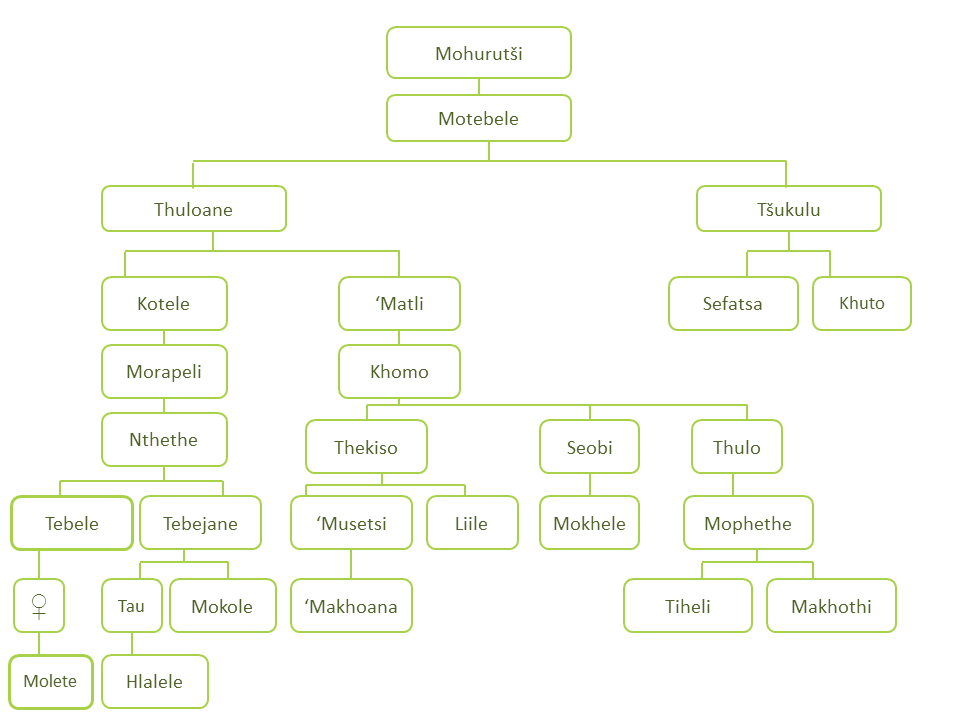
Enough with my babble! Now, in the spirit of sharing my joy, below is a condensed version of Ntate Ramakhula’s article, inclusive of an enthusiastically generated graphic of the Bataung genealogy:

Tebele did not bear a male heir, but tried to enforce his daughter’s son to be his heir and the head of Bataung. Contrary to the custom, he married a son in law for his daughter into his family and their progeny was thus declared, but, his subjects nullified the declaration, hence, Molete, the son from his marriage was denied the seniority. […] If gender issue had not been negative, the Bataung ba Ha Molete would have been the most senior.

bataung_tree

  1. Qiloane is a conical mountain, which has inspired the design of the traditional Basotho hat, “mokorotlo”. In my romantic patriotic heart, a future built on top of Qiloane amounts to nurturing a relationship in an elevated pedestal of mutual respect, where trust and openness make it possible to sustain winds (of change/life) coming in varying speeds from different directions.
  2. Motla-a-pepiloe in many ways is akin to the word black. Mainly in that its use can be vulgarised and perverted in a manner that impacts self-esteem; unless, of course, one learns to see it as a mere adjective.
  3. Tšeliso Ramakhula, Looking at the Origins of Bataung, Visions, Vol. 8, p 41-42
Share

Frankly in Awe

When I desire a downtime with some hint of enjoyable intellectual stimulation I listen to Sankomota. I started this ritual not so long ago while feeling a bit homesick. And I continue with it because I am on a very private quest to truly appreciate and/or understand Frank Leepa.

Baholoane (elders) have always declared that he was a (musical) genius, but the ‘ageist’ in me took the declaration with a pinch of salt. I believed he was good but thought the use of genius was a stretch; precisely because baholoane, true to their nature, weren’t keen to explain/justify/defend their declaration.

Now, here I am; ready to read from the same page as baholoane – or rather, sing the same tune with them! How and when did I get to this place? This is rhetorical; destiny has beckoned me to where I am. The question is: can I differentiate myself from baholoane and provide an explanation, however flawed, of why I think Frank Leepa is a genius?

For me, his genius lies in how he imbues latent messages into his (or more accurately Sankomota’s) songs. I think it is absolutely awe-inspiring. Listening to a song like Obe you find melody and lyrical depth encapsulated by humour, wit, sarcasm, irony and whatever else you can think of. Of course, this all depends on interpretation!

Obe: Ode of note

Obe for those who may not know is based partly on J.P. Mohapeloa’s literary works. Obe is a beast that a girl meets for the first time after entering married life. The first part of the song is about describing this beast from the girl’s perspective. It is also about her reaction and the response of the knowing adults. The second part of the song is a plea to humanity, requesting a change for the better. This plea is very powerful, in part because of the wonderfully heavy voice making it: Tšepo Tšola’s voice!

Distinguishing the parts is trivial: the first part is in Sesotho while the second is in English. The triviality, in a small way, contributes to Frank’s genius. What spells it for me (in a big way) is how he fused the two parts together. I personally give him credit on two main counts:

  1. For the instrumentals that transition the listener from one part to the next. For me, these instrumentals create an exceptional bridge that allows me to pause and soak in the sounds from different musical instruments, float with each note, but still remain grounded in the harmony of sounds created in concert of each other.
  2. For the crafting of the overall message, which can simply and elegantly be reduced to: “Make love not war”! Once you understand what each part is about, the clue for making the reduction (or rather deduction) lies in the second part of the song. Specifically, it is embedded in the following words (or at least based on my interpretation): “You are robbing each other. You are killing each other. […]. There must be some way to bring this change. Why don’t you reach out and touch somebody’s hand?

Malala Pipe: Dream of hope

In Obe, Frank is a force in the background. To appreciate his genius/talent both in the background and foreground, I believe no song does it better than Malala Pipe. Beyond writing and working on the arrangement of the song, in its performance he leads in every sense of the word. The guitar, his instrument of choice, dominates and he, not Tšepo Tšola, leads the vocals.

What makes Malala Pipe an absolute work of art is its simplicity. The message of the song is simple yet profound. Hearing the unmistakable voice of Tšepo trail behind gently and powerfully in the background enhances the message even further. Conviction as a word and emotion get personified through Frank’s voice. In my mind, this allows one to see Frank Mooki Leepa in a whole new light that also cements his calling in life.

Apart from getting to enjoy the authentic voice of Frank in Malala Pipe, there is a layer of depth for those of us who expect a little hidden treasure from his songs. For me, the treasure is buried in the chorus: “Umalala, Malala pipe; Umalala, Malala pipe no more”. This roughly translates to “you sleep in the trenches; you sleep in the trenches no more”. An in-context translation yields an interpretation suitable to satisfy two kinds of people: those whose luck has run out entirely and those with lady luck still on their side but have not yet self-actualised.

I certainly admit that for those in the latter group, to get an appropriate interpretation, the chorus may need to be unpacked a bit. Mainly in that every individual has to be connected to a pipe laid down as a conduit to channel God’s love and purpose for each one of us. But unlike ordinary pipes, we need to self-actualise, hence the statement “Malala Pipe no more“. I could attempt to justify how I got to this interpretation, but I think the lyrics of the song say it all – and perhaps, in a small way, also reflect why I am frankly in awe of the late Frank Mooki Leepa:

I believe
you were born for greatness
the light in your eyes
is a spark of God
I believe oh, oh,
a child is born with a heart of gold

Umalala, Malala pipe
Umalala, Malala pipe no more

I believe
man was born for greatness
and the light in his eye is a spark of God
I believe oh, oh,
Oh oh, a child is born,
with a heart,
a heart of gold

Umalala, Malala pipe
Umalala, Malala pipe no more

© http://frankleeparevival.com/THEMESSAGELYRICS.html

Share

Sekoboto

Recently when I was preparing for yet another scholarship application, I was reminded of a story my mother shared with me a little over a decade ago. At that time, she was working predominately with TB patients.

The story goes as follows: When an elderly man was asked why he had stopped taking his TB medication i.e. defaulted, he responded with a chuckle. A chuckle filled with a touch of sorrow, gentility and genuineness, all fused together by a healthy dose of amusement to remove any traces of malice. Then he went on to say: “ngoanaka, u botsa hobane u sa tsebe sekoboto“!

Pretty much, that was the sum total of the man’s response. Unfortunately for me, when I heard the story, I failed to realise how profound a response it was. I laughed for I found the re-enactment of the chuckle really funny. And, to a small degree, because (as a Mosotho child) I have been raised to believe that laughter is greater than death itself, “lefu-leholo ke lits’eho“. This said, the bottomline is: I failed to move beyond laughter by failing to engage in any substantive manner with the vocalised part of his response, which translates to: “my child, you ask because you don’t know what sekoboto is!”

Now, allow me to redeem myself by explaining first what sekoboto is and then what I believe the elderly man was saying. Sekoboto, in a nutshell, refers to famine,”tlala ea boja-likata”. But there is slightly more to this famine; assuming of course, that famine was something ordinary. Sekoboto refers to an extreme kind of famine that corrodes the body and the soul with intensity that cannot be described fully in words.

So, notwithstanding the implication that words may not be adequate to express what the elderly man said, I shall nevertheless make an effort to unpack his statement. In my opinion, I think this is what he was trying to communicate:

A stomach that knows not sekoboto, laments on having “meal X” yet again; for it understands not the panic of not knowing where the next meal is coming from. It laments because choice is not a word that exist only in theory: choice is a right embedded in its existence. And indeed, while that choice may be limited, it is not as dire as having to choose between aggravated pain of starvation and a speedy escape from starvation granted by death!1

Personally, I haven’t experienced the sekoboto that the elderly man was referring to. But, I certainly do relate. For this, I thank some of the questions that have been included in my scholarship application(s), particularly those that required me to articulate the invisible barriers as a black woman in science, with an urban middle-class background.2 For many of these questions, I truly felt like providing a loaded response akin to the one the elderly man gave; but of course lacking the wisdom that comes with age, I couldn’t!

  1. TB medication increases appetite and if you already struggle with what to eat on a daily basis this becomes an aggravation. Not just any kind of aggravation: a painful one that may ultimately cause you to rethink what quality of life means!
  2. This possibly explains why I haven’t been successful with my applications :-(. Perhaps, I couldn’t explain that middle-class can simply translate to not being in a sekoboto situation, where sleeping on an empty stomach for days is a norm. Or may be I couldn’t (adequately) explain that subordination of women from “committed parties” is the same, be it you are an urban or rural dweller, black or white, in science or humanities, etc. Who knows?
Share