2013 — A year of tribute

I awake from my slumber. Awaken by an article in the entertainment section of the last edition of City Press. A well deserved tribute paid to one of “Lesotho’s finest music export”, Tsepo Tshola.

The tribute in the traditional paper version starts with the “quintessence of Tsepo Tshola” captured through the lens of the photographer – a very gifted photographer, may I add. So gifted that I really had to pause and immerse myself in the sectional cover before I could proceed to page 6 and 7 for the written tribute by Lesley Mofokeng.

For the most part, I thoroughly enjoyed the tribute. The only thing that actually didn’t sit well with me was having Frank Leepa parenthesised. My reaction was: “really Lesley? You are that guy?!” (The guy who puts in parenthesis Frank Mooki Leepa – the man who has written some of the most beautiful lyrics that speak to the core of my being.)

But I have digressed, so let me quickly get to the point I truly want to make. In paying tribute to Tsepo Mobu Tsola — a tribute he rightfully deserves — Lesley allowed me to think deeply (or differently) about 2013.

For me, 2013 was but going to be a do-or-die year. And in terms of what to do, all I could do is work, work and work at finishing my thesis. But what’s work without taking a little time to pay tribute to people, things, and ideas that are dear?

I mean, how could I have allowed myself to have such narrow view of 2013? The year in which a movie that pays tribute to King Moshoeshoe I will be premiered. The year of celebrating 50 years of the coming together of African states (under OAU) and the birth of His Majesty King Letsie III. The year which, as I see it, provides an opportunity to celebrate both death and life – and other binaries that may exist — for if, say, you look through the prism of Sankomota, this is the year that marks 10 years of the passing of Frank and 60 years of living for Tsepo. How profound is that? Again, I ask: how could I have possibly had such a narrow view of 2013, when it clearly seems to be a year of tribute?!

Birding: An Inspiration for Courtship

What do I know about birding? Very little, indeed! Still, since I have already entered the realm of birders in my last posting, I thought one additional flight wouldn’t possibly hurt.

However, to ensure that I don’t overstep on any boundaries, I will confine my flight to the courtship zone. This zone appeals to me for a number of reasons, but mostly because it gives me a rare insight into the minds of the men from my part of the world.

I come from a world where birding is an activity that is generally enjoyed by members of the opposite sex, especially those who have herded and cared for livestock as young boys. I suppose this can be explained by the fact that herding typically happens in the wild where mother nature happily provides her lessons while inspiring most of the entertainment for the lads. Naturally, I could be wrong to assume there is a connection between spending time in the wild and having an affinity for birding. But frankly, my experience as a “supposed bird” suggests otherwise.

During courtship, I have been enthralled by prose filled with awareness of nature (the environment including the birds) from those with herding experience. They have proven to have an ability to spin a mundane expression like “nonyana e ts’oaroa ka menoto”, which suggests that a bird is ‘captured’ by its legs, to flatter a star like Tina Turner and mortal like me.

Of course, given the magnificent legs of Tina (that apparently go on forever), the prose used would liken her to a mystical secretary bird — yet to be seen, even by twitchers of note. This mysticism, in my opinion, is possibly conveyed by a spirit of another bird that can satisfy a deep yearning for reciprocity. My guess would be a bird in the sparrow hawk family. Apparently if you ask really nicely, “seotsanyana, nkopele” 1 (sparrow hawk, flap your wings for me), it spreads its wings and hovers in the air as though to say: “happy to delight you”.

Unlike with Tina, for me attention would be on something else, perhaps the colour of my feathers (personality). The legs wouldn’t play much of a factor. The legs would be mere instruments for grabbing hold of me — or to be precise, my attention, so I don’t escape before considering the prospects of nestling the would-be beautiful babies that my suitor and I could have.

On this ‘nestling’ note, let me gracefully land and/or end my flight. I hope the view has been spectacular. And to a degree, I hope through my courtship experience(s) I have managed to provide a small insight into some aspects in my language and/or culture that I am yet to find the words to fully articulate ;-)!

  1. This comes from a traditional (folk) song, which was perhaps popularised by the late Sefatela at the turn of this century.

Tears of Gratitude for a Rare Bird

[I] say not in grief ‘he is no more’ but in thankfulness that he was.- Hebrew Proverb

For over a decade, on this day I have a private sobbing session. This morning was no different! I woke up and allowed myself to succumb to overwhelming feelings of fondness from simply remembering memories of a life that is no more.

I snorted and cried like an inconsolable child, especially when I realised my own selfishness/foolishness. Until today, it never quite dawned on me that my loss wasn’t just mine. There are loved ones out there, who might have understood all this time, that I have this sobbing session to simply acknowledge that indeed I have experienced love in my life time. A love from an imperfect but caring uncle, who was very protective of his family. A man who convinced me, among many other things, that it is not blasphemous to declare Bob Marley a saint (and in my opinion, “a true heritage icon for the world” )!

My all-rounded uncle, malome-rangoane Sammy, graces us no more with his wings in the air, but I am sure glad that I remember with great fondness his flight. To me, he remains a rare bird that I am thankful to have seen fly and grace the skies of my existence, even if only for a fleeting moment.

So, with unabashed gratitude, today (and in the future) I will allow myself to sob and/or weep for this rare bird, for its flight (including the gliding away flight) remains memorable to me. In part, because a certain realisation of its glorious purpose (at least to my life) deepened in death, much like a thorn bird reaches its potential in death. (Arguably, this may sound warped, but I do believe in the idea of death bringing out the most glorious sound from a thorn bird.) For this reason, I cannot curse death; I can but cleanse my soul with tears of gratitude and let the words “memento mori” propel me forward!

Vuka and Spruce up the Language!

Vuka, awake! A season of rebirth or new beginnings has arrived. For many people, including myself, it is a season for de-cluttering our emotional, intellectual and physical environment. A season in which we are inspired by nature itself to create space for new ideas, people and things.

As we de-clutter, we ask ourselves a number of critical and reflective questions to rid ourselves and our environment of certain things, while we keep or protect those things that we cherish. The question is: do we ever remember to ask questions that may allow us to value language in the context of our environment? I don’t just mean in terms of using language to send positive vibes in our environment; I mean in terms of truly reclaiming ourselves, and connecting deeply to our environment and heritage!

Indeed, I am well aware of the increasing and commendable efforts by many countries and individuals to protect their environment and heritage. But when it comes to dealing with language, I feel the spirit of lumping together the protection of the environment and heritage is lost.

Otherwise put, although language is central to heritage, I think we have done a poor job in framing its importance within the context of the environment and its protection. As such, I think people still have difficultly in seeing the extend of the overlap between issues of the environment and that of heritage (cultural or otherwise). They fail to see the embeddedness of issues of heritage within the broad set of issues of the environment. Mathematically speaking, they fail to conceptualise heritage issues as but a proper subset of environment issues.

In my mind, without this conceptualisation, being connected to the broad vision of the country, continent or planet would remain a challenge. At the moment, though saving the rhino is as important as saving my Sesotho language, I sometimes forget this truth. While this is an embarrassing admission to make, with the arrival of spring, I hope to wake up permanently from a slumber that sometimes denies me of this truth.

Happy spring to all. May the beauty brought by the season inspire us to spruce up our views on language … to see beyond its functional use … and be moved to find ways in which we (re)enchant its use to (re)connect to the richness of our heritage and the environment as whole!

A Stand Against Rape

For a holiday, I had a very productive morning: taking a moral stand. I joined an anti-rape march, organised in solidarity with community members of Grahamstown East, as part of an ongoing quest for justice for the two siblings, aged 6 and 7, raped by their school teacher.

We marched declaring proudly that rape was not part of our culture and necessarily not part of the curricula! What was troubling to me was how few men were actually present at the march.

I believe only a few men are rapists. I also believe in order to paint this reality we need to see more men taking a visible stand against rape. The question then is: how can we get more men to be visibly involved in activities that will allow positive construction of masculinity?

Men — speaking only on my behalf — I need to see more of you lest I start thinking what I see in marches, like one we had today, is representative of some reality. Please don’t wait until it is your blood relative or your partner to take a visible stand against rape, sexual violence and all other forms of patriarchy. Stand now to prevent false construction of masculinity; and more importantly, to help stop the war on women and children’s bodies!

Fury of Unuttered Words

On many occasions I attempt to express myself in silence. While I believe this can be a powerful form of expression, I often find that others interpret it as being docile or some oblivious fool/idiot. For yours truly, this generates a fury that far exceeds that of a supposed scorned woman.

This fury torments and fires the soul to hell with one goal in mind: to have words uttered, and not just for utterance sake. The fury demands absolute honesty! Paradoxically, the fury voices its demand in subtle but cunning ways. “You are a free individual”, a voice from within says. “Speak for you will remain a prisoner of (my) fury”. This voice continues until it can no longer be ignored: “speak; speak; speak!”! And what was initially an innocent voice of reason changes to a nagging that surpasses all forms of hell. A hell not imposed by another being/creature but one that stems (uncontrollably) from within.

To end this nagging/hell, free yourself and be bold to utter those words which others may not be prepared to say. Say what you must, for this is all that the fury demands of you. You ignore this demand, the fury of unuttered words becomes unrelenting in its pursuit for truthful words to be uttered –precisely because the fury also serves as an officer for the enforcement of the following law: ‘the truth shall set you free“!

A Babble plus Bataung Genealogy

On a number of occasions, I have declared myself as a descendent, by marriage, of Molete within the Bataung clan, “ke motaung oa Molete ka lenyalo“. This statement, loaded as it is, has failed to arouse (m)any questions. I suspect this has little to do with the fact that I am unmarried in the sense of exchanging vows to a soul mate and promising, in metaphoric terms, to build a future at the pinnacle of Qiloane, “ho haha bokamoso (ba motse oa rona) qooeng ea Qiloane. 1

I believe it has much ado about how I make the statement. I do it with a mischievous glimmer in my eyes, masked ever so slightly by my version of a dexterous detached attitude that makes it possible to embrace the label: “motla-a-pepiloe”, a child begotten on her mother’s back into marriage 2. This attitude is by no means unfriendly to deter people from probing me with questions. I merely suspect that people choose not to ask because they assume they know what it is I am alluding to, even though this may just be one side of the story.

This said, let me assure you that there is another side to my declaration, which, in my opinion, truly roots my identity (especially as a proud feminist who is mindful of the power of choice that comes with adulthood). This side pertains to a piece of history where a woman married a man in order to carry her family name forward. Specifically as it applies to my choices as an adult, it is about choosing to identify with a piece of matriarchical history that some would prefer to ignore or phrase in a manner that eliminates a woman totally from the picture.

Ntate Ramakhula in his article about the “genealogy of Bataung” 3 makes mention of this history. I must say, seeing it in black and white almost made me fall off a chair with glee. However, I was slightly disappointed by failure to once again acquire the name of a woman that history wants to forget; I don’t mean her alias ‘Mamolete, which references her by the son she bore.

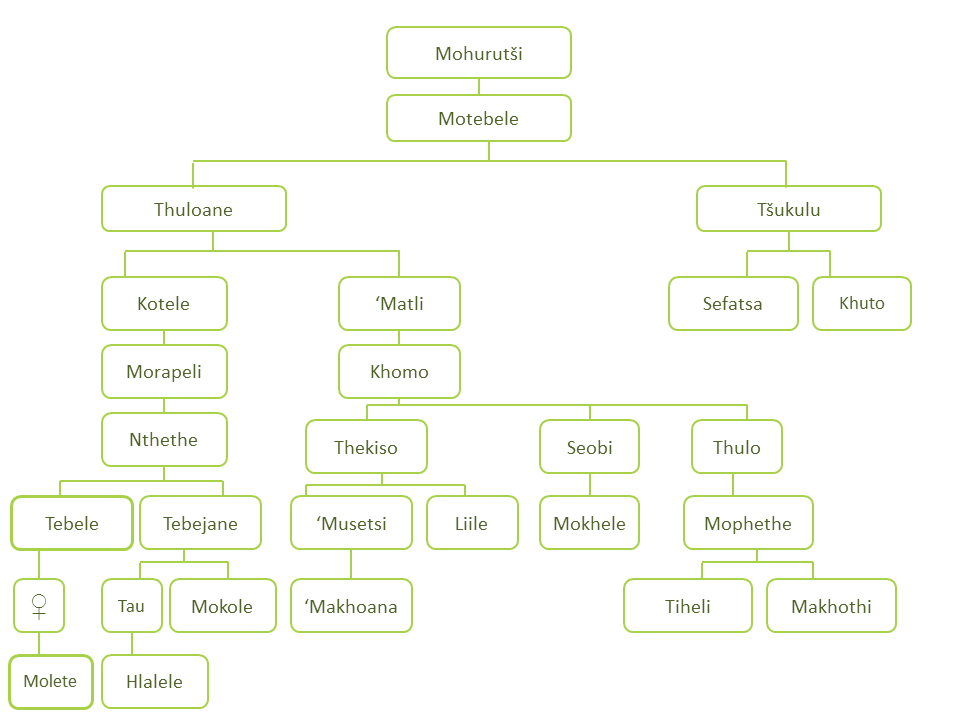
Enough with my babble! Now, in the spirit of sharing my joy, below is a condensed version of Ntate Ramakhula’s article, inclusive of an enthusiastically generated graphic of the Bataung genealogy:

Tebele did not bear a male heir, but tried to enforce his daughter’s son to be his heir and the head of Bataung. Contrary to the custom, he married a son in law for his daughter into his family and their progeny was thus declared, but, his subjects nullified the declaration, hence, Molete, the son from his marriage was denied the seniority. […] If gender issue had not been negative, the Bataung ba Ha Molete would have been the most senior.

bataung_tree

  1. Qiloane is a conical mountain, which has inspired the design of the traditional Basotho hat, “mokorotlo”. In my romantic patriotic heart, a future built on top of Qiloane amounts to nurturing a relationship in an elevated pedestal of mutual respect, where trust and openness make it possible to sustain winds (of change/life) coming in varying speeds from different directions.
  2. Motla-a-pepiloe in many ways is akin to the word black. Mainly in that its use can be vulgarised and perverted in a manner that impacts self-esteem; unless, of course, one learns to see it as a mere adjective.
  3. Tšeliso Ramakhula, Looking at the Origins of Bataung, Visions, Vol. 8, p 41-42

Sekoboto

Recently when I was preparing for yet another scholarship application, I was reminded of a story my mother shared with me a little over a decade ago. At that time, she was working predominately with TB patients.

The story goes as follows: When an elderly man was asked why he had stopped taking his TB medication i.e. defaulted, he responded with a chuckle. A chuckle filled with a touch of sorrow, gentility and genuineness, all fused together by a healthy dose of amusement to remove any traces of malice. Then he went on to say: “ngoanaka, u botsa hobane u sa tsebe sekoboto“!

Pretty much, that was the sum total of the man’s response. Unfortunately for me, when I heard the story, I failed to realise how profound a response it was. I laughed for I found the re-enactment of the chuckle really funny. And, to a small degree, because (as a Mosotho child) I have been raised to believe that laughter is greater than death itself, “lefu-leholo ke lits’eho“. This said, the bottomline is: I failed to move beyond laughter by failing to engage in any substantive manner with the vocalised part of his response, which translates to: “my child, you ask because you don’t know what sekoboto is!”

Now, allow me to redeem myself by explaining first what sekoboto is and then what I believe the elderly man was saying. Sekoboto, in a nutshell, refers to famine,”tlala ea boja-likata”. But there is slightly more to this famine; assuming of course, that famine was something ordinary. Sekoboto refers to an extreme kind of famine that corrodes the body and the soul with intensity that cannot be described fully in words.

So, notwithstanding the implication that words may not be adequate to express what the elderly man said, I shall nevertheless make an effort to unpack his statement. In my opinion, I think this is what he was trying to communicate:

A stomach that knows not sekoboto, laments on having “meal X” yet again; for it understands not the panic of not knowing where the next meal is coming from. It laments because choice is not a word that exist only in theory: choice is a right embedded in its existence. And indeed, while that choice may be limited, it is not as dire as having to choose between aggravated pain of starvation and a speedy escape from starvation granted by death!1

Personally, I haven’t experienced the sekoboto that the elderly man was referring to. But, I certainly do relate. For this, I thank some of the questions that have been included in my scholarship application(s), particularly those that required me to articulate the invisible barriers as a black woman in science, with an urban middle-class background.2 For many of these questions, I truly felt like providing a loaded response akin to the one the elderly man gave; but of course lacking the wisdom that comes with age, I couldn’t!

  1. TB medication increases appetite and if you already struggle with what to eat on a daily basis this becomes an aggravation. Not just any kind of aggravation: a painful one that may ultimately cause you to rethink what quality of life means!
  2. This possibly explains why I haven’t been successful with my applications :-(. Perhaps, I couldn’t explain that middle-class can simply translate to not being in a sekoboto situation, where sleeping on an empty stomach for days is a norm. Or may be I couldn’t (adequately) explain that subordination of women from “committed parties” is the same, be it you are an urban or rural dweller, black or white, in science or humanities, etc. Who knows?